
eLibrary: Afrasiab
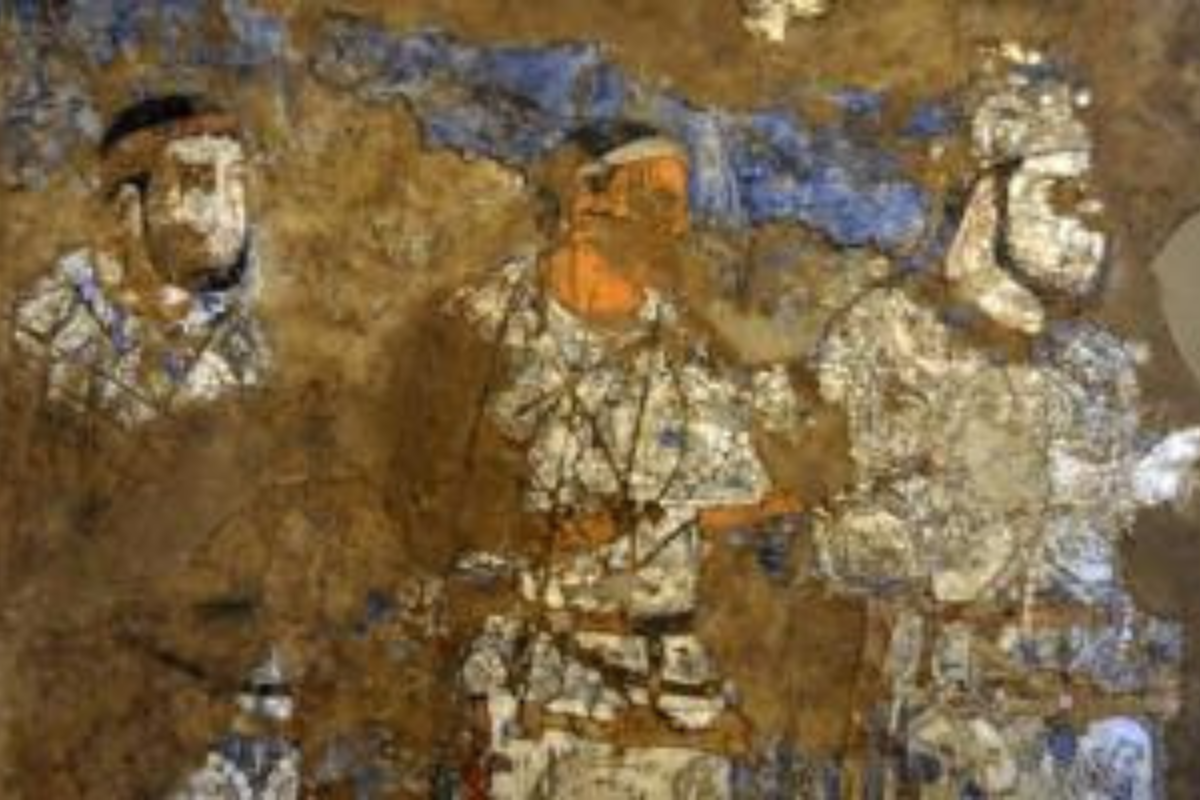
Welcome to this virtual journey into Samarkand's Afrasiab murals, rare survivors of a vanished world. Painted in the 7th century, these fragments once decorated the palace of the rulers of ancient Samarkand, depicting ambassadors, processions, and encounters along the Silk Roads. Though damaged by time, their colours and images still speak across centuries. Step into a space where history, art, and imagination meet. Our Afrasiab exhibition invites you to see, reflect, and connect-before, perhaps, experiencing the original murals in Samarkand itself.
This is the latest version of an electronic library of resources supporting the exhibition. It offers free and immediate access to online resources for anyone wanting to explore further the context of the museum’s artifacts. As the museum develops, more resources, in more languages, will be added.
NOTE: Some of these links come from Academia.edu and Researchgate.net. These require a free one-time registration. To research further yourselves, you may consider registering with Jstore.org which gives limited but free monthly access to its collections
Articles
Anarbaev, A.A., e.a. 2023. Traces of Strong Earthquakes in Ruins of the Afrasiab Archeological Site (Samarkand, Uzbekistan). Moscow University Geology Bulletin, 78, 5, 565–572
Arzhantseva, I. 2006. Afrasiab wall-paintings revisited: New discoveries twenty-five years old. Rivista degli studi orientali. 185-211.
Azarpay, G. 2014. The Afrasiab Murals: A Pictorial Narrative Reconsidered. Silk Road 12, 49-56.
Bakry I., 2025. Uzbekistan’s Strategy of Preserving and Displaying the Afrasiab murals “Development for Sustainable Preservation”. Historia i Świat, 14, pp.143-155.
Cristoforetti, S., 2007. The “Hall of the Ambassadors” paintings in the frame of the calendrical system of the Iranian world. In The Chinese scene at Afrasyab and the Iranian calendar (Vol. 78, pp. 33-71). Editrice Cafoscarina.
Dilsholda, S. 2015. About Modern Graphic Reconstruction Wall Painting Of The Throne -Room Of Afrasiab. International Journal of Scientific & Technology Research, 4, 7, 88-90
Géraldine Fray, G. e.a. 2011. A Pastoral Festival on a Wall Painting from Afrasiab (Samarkand). Journal of Inner Asian Art and Archaeology, 6, 53-75.
Grenet, F., 2007. The 7th Century AD ‘Ambassadors Painting’at Samarkand. Mural Paintings of Silk Road, pp.9-19.
Grenet, F. e.a. 2011 A pastoral festival on a wall painting from Afrasiab (Samarkand). Journal of Inner Asian Art and Archaeology, 6, 53-73, 221-224.
Holakooei, P., e.a.2019. Non-invasive scientific studies on the provenance and technology of early Islamic ceramics from Afrasiyab and Nishapur. Journal of Archaeological Science: Reports, 24, pp.759-772.
Marshak, B., e.a. 1994. Le programme iconographique des peintures de la «Salle des ambassadeurs» à Afrasiab (Samarkand). Arts asiatiques, pp.5-20.
Moon, D.H. e.a. 2021. Ancient Pigments in Afrasiab Murals: Characterization by XRD, SEM, and Raman Spectroscopy. Minerals,11, 9,
Shoira, H., 2024. Glazing and Unglazed Pottery in Afrasiyab: A Study 0f 7th-12th Century Transoxanian Ceramics. Research Focus, 3(9), pp.89-92.
Yatsenko, S.A., 2004. The Costume of Foreign Embassies and Inhabitants of Samarkand on Wall Painting of the 7th c. in the ‘Hall of Ambassadors’ from Afrasiab as a Historical Source. Transoxiana, 8, p.75.
Videos
3D reconstruction of frescos on the ancient settlement Afrosiab, Samarkand, Uzbekistan (Samarkand Museums) 9.41