
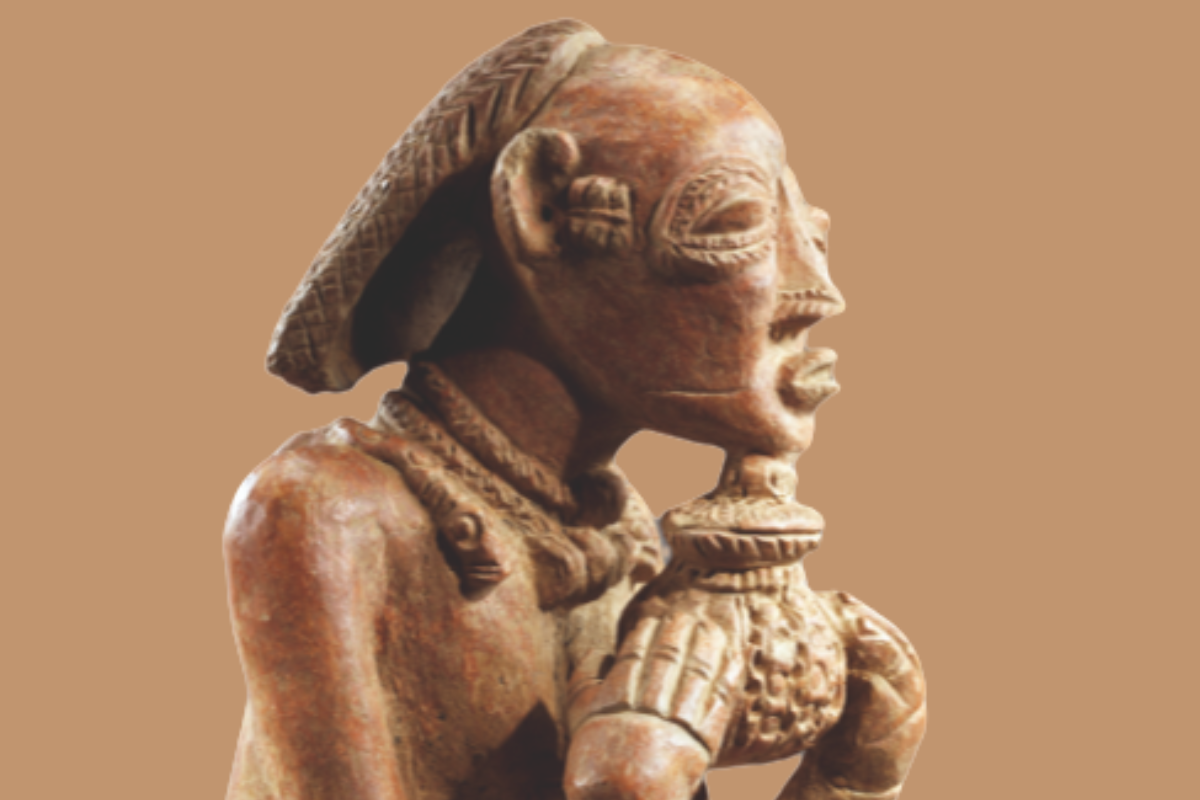
eLibrary: Mali
The Mali Empire (c. 1235-1470) expanded from the upper Niger River to dominate West Africa. It’s power rested on control of key resources and the trade routes that carried them across the Sahara. Mali’s exports included gold from the Bambuk and Bure fields, salt from desert mines at Taghaza and Taoudenni, ivory from the savannah and forest elephants, and kola nuts, much prized as stimulants and as ritual offerings.
This is the latest version of an electronic library of resources supporting the exhibition. It offers free and immediate access to online resources for anyone wanting to explore further the context of the museum’s artifacts. As the museum develops, more resources, in more languages, will be added.
NOTE: Some of these links come from Academia.edu and Researchgate.net. These require a free one-time registration. To research further yourselves, you may consider registering with Jstore.org which gives limited but free monthly access to its collections
Articles
Abbou, T., 2016. Mansa Musa’s journey to Mecca and its impact on Western Sudan.
Awortu, B.E. and Michael, T.B., 2018. Leadership in Pre-Colonial Africa: A Case Study of Sundiata Keita (Mari Jata) C. 1217-1255 and Mansa Musa Keita (Kankan) C. 1312-1337 of Mali. International Journal of Novel Research in Humanity and Social Sciences, 5(1), pp.28-36.
Berzock, K.B. 2019. Caravans of gold, fragments in time. Art, culture, and exchange across medieval Saharan Africa
Camara, S., 2020. The history of the Notion of the State in West Africa: from the destruction of empires to the emergence of the modern state resulting from colonization (the case of the Mali Empire). RUDN Journal of World History, 12(1), pp.28-34.
Canós-Donnay, S., 2019. The empire of Mali.
Cartwright, M., 2019. Mali Empire. World History Encyclopedia.
Collet, H., 2019. Échos d’Arabie. Le Pèlerinage à La Mecque de Mansa Musa (724–725/1324–1325) d’après des nouvelles sources. History in Africa, 46, pp.105-135.
Dafaga, A., 2021. Mansa Moussa dans les récits des auteurs musulmans, MA Thesis, Lyons3
De Grunne, B and K van Dijk, 2016. Mande. Tresors Millenaires Ancient Treasures. 98pp
Demirer, A., The Image of Timbuktu between Imagine and Reality.
Dewière, R., 2023. Hadrien Collet, Le sultanat du Mali. Histoire régressive d’un empire médiéval xxie-xive siècle. Bulletin critique des Annales islamologiques, (37).
Doi, A.R.I., 1987. Mud Mosque and Their Decoration in West Africa. In The Proceedings of the Hijra Celebration Symposium on Islamic art, Calligraphy, Architecture and Archaeology (Vol. 2, pp. 430-1).
DRAMÉ, S.S., Timbuktu: A Forgotten Islamic Legendary City!.
Eaton, R.M., 2011. From Bidar to Timbuktu: Views from the Edge of the 15th Century Muslim World. The Medieval History Journal, 14(1), pp.1-20.
Garenne-Marot, L. and Mille, B., 2007. Copper-based metal in the Inland Niger delta: metal and technology at the time of the Empire of Mali. Metals and Mines: Studies in Archeometallurgy, pp.159-68.
Hameed, A.A., 2024. The role of the rulers of western Sudan in civilized communication with the Arab Islamic world Manasseh Musa (712-738 AH/1312-1337 AD) as an example. College Of Basic Education Research Journal, 20(1), pp.474-490.
Imperato, P.J. 2021. The Depiction of Smallpox and Other Dermatologic Lesions on the Surfaces of Ancient Terracotta Statues from Mali, West Africa, Journal of Community Health
Jansen, J., 2018. Beyond the Mali empire—A new paradigm for the Sunjata Epic. The International Journal of African Historical Studies, 51(2), pp.317-340.
Klesmith, E.A., 2013. Nigeria and Mali: The case for repatriation and protection of cultural heritage in post-colonial Africa. Notre Dame J. Int'l & Comp. L., 4, p.45.
Lunn, Z.R., 2015. Mali’s Literacy and the Islamic Influence. REViSiONS, p.22.
Ly-Tall, M., 1984. The decline of the Mali empire. General History of Africa IV, pp.172-86.
Mali, P.I., 2025. Mali Empire. Sat.
McKenzie, P., Nothing Gold Can Stay: The Drastic Decline of the Mali Empire.
Mora, K. 2025. The Great Mosque of Djenné And the Social Utility of History, Republic, 9, 1.
Person, Y., 1981. Nyaani Mansa Mamudu et la fin de l’empire du Mali. Publications de la Société française d'histoire des outre-mers, 5(2), pp.613-653.
Roe, M.B., 2011. Timbuktu: From Myth to reality of Mali's Fabled City. Chronos, 6(1), p.11.
SCHULTZ, W., 2006. Mansa Miisa's Gold in Mamluk Cairo: A Reappraisal of a World Civilizations Anecdote. History and Historiography of Post-Mongol Central Asia and the Middle East, p.428.
Silverman, R.A., 2016. Material Biographies: Saharan Trade and the Lives of Objects in Fourteenth and Fifteenth-Century West Africa, History in Africa / Volume 42 / June 2015, pp 375 – 395
Togola, T., 2003. The rape of Mali’s only resource. In Illicit Antiquities (pp. 262-268). Routledge.
Videos
Lost History: the terracotta sculpture of Djenné Djenno (Smarthistory) 6.02mins
Scrofulous Sogolon — An X-Ray Scan of the Sunjata Epic (Marc Ghysels) 27.11mins