
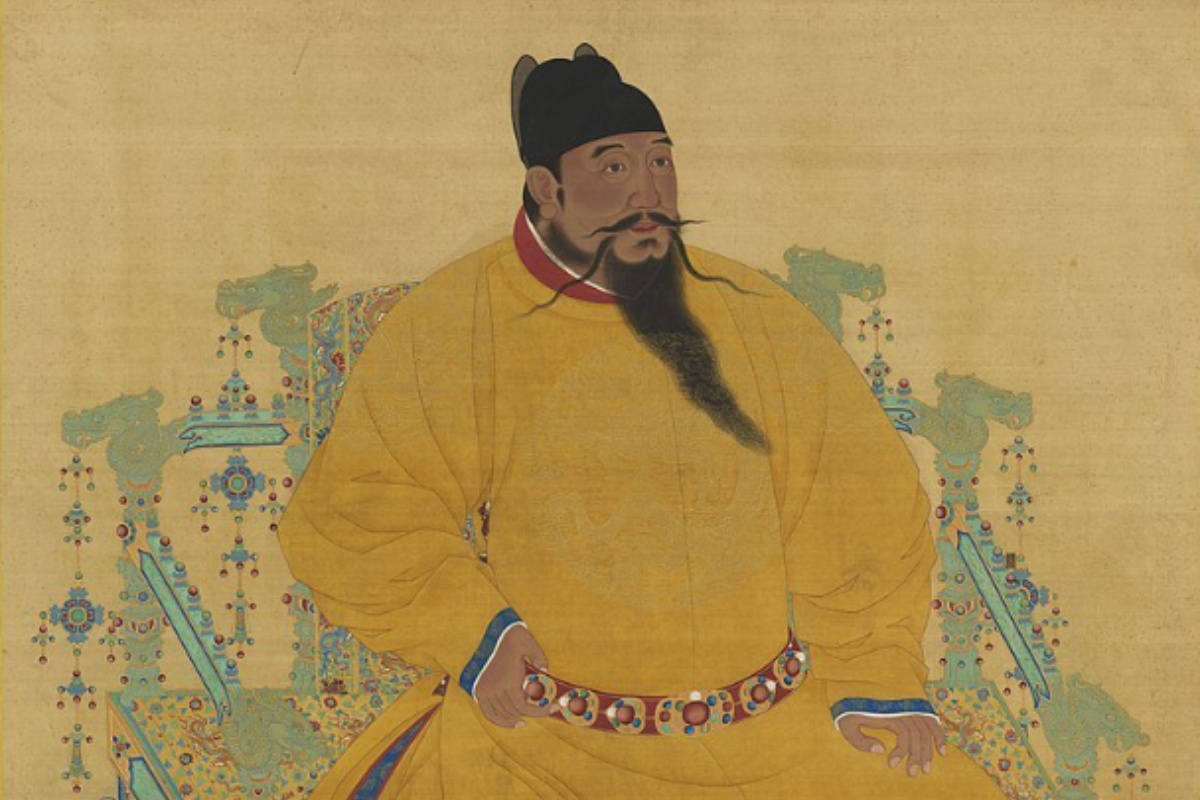
eLibrary: The Yongle Emperor
After seizing the throne in 1402 amidst a crisis of legitimacy, Zhu Di transformed an uncertain beginning into one of the most assertive and ambitious reigns in Chinese history. Over just two decades as the Yongle Emperor, he dramatically reshaped China's geopolitical landscape by moving the capital to Beijing, building the Forbidden City, projecting power overseas via vast treasure fleets, and commissioning the world's largest encyclopedia.
This is the latest version of an electronic library of resources supporting the exhibition. It offers free and immediate access to online resources for anyone wanting to explore further the context of the museum’s artifacts. As the museum develops, more resources, in more languages, will be added.
NOTE: Some of these links come from Academia.edu and Researchgate.net. These require a free one-time registration. To research further yourselves, you may consider registering with Jstore.org which gives limited but free monthly access to its collections
Articles
Anderson,J .A., 2020. “The Ming Invasion of Vietnam, 1407-1427” in David C. Kang and Stephan Haggard (eds.) East Asia in the World: Twelve Events That Shaped the Modern International Order. Cambridge: Cambridge University Press,.
Andrade, T., 2019. ‘How Yongle learned to stop worrying and love the gun. Perspectives on early Ming history’, The Ming World, Routledge,
Barmé, G.R., 2008. The Forbidden City. Harvard. 289pp
Chen, C. and Ruangchewin, P., 2025. Research on the Cultural and Museum Intellectual Property of Yongle Palace. Asian Journal of Arts and Culture, 25(2),
Chen, X., Chizzoniti, D. and Lolli, T., 2025. The Role of Mythology in Architectural Identity: The Case of the Temple of Heaven. ARPHA Proceedings, 9, pp.27-36.
Church, S.K,, 2005.‘Zheng He: An Investigation into the Plausibility of 450-Ft Treasure Ships’, Monumenta Serica, 2005.
Church, S.K. 2011., ‘Two Ming Dynasty shipyards in Nanjing and their infrastructure’, Shipwreck ASIA: Thematic Studies e Archaeolog y, Adelaide
Finlay, R., 2008. ‘The Voyages of Zheng He: Ideology, State Power, and Maritime Trade in Ming China’, The Journal of the Historical Society, 7, 3, 2008.
Gao, J.I.E., 2016. Symbolism in the Forbidden City. Education about Asia, 21(3), pp.9-17.
Hucker, C.O. The Ming Dynasty its Origins and Evolving Institutions, Michigan Papers in Chinese Studies, 34, 1978.
Lotze, J.S., 2017 Translation of Empire: Mongol Legacy, Language Policy, and the Early Ming World Order, 1368-1453, PhD Thesis, Univ. Manchester.
Ngan, Q., 2022. Destined to rule: The symbolism of the jade-colored throne in the Yongle emperor’s portrait. Notes in the History of Art, 42(1), pp.14-24.
Qujie, S. 2002., Reconciliation and legitimization : the fifth karmapa deshin shegpa's trip to ming china. MA Thesis, British Columbia
Romero Viturro, R., 2024 El almirante Zheng He y los viajes de la flota del tesoro. PhD Thesis, Universidad Católica Argentina
Sen, T., 2019. ‘Zheng He's Military Interventions in South Asia, 1405–1433’, China and Asia
Sen, T., 2016. The impact of Zheng He's expeditions on Indian Ocean interactions. Bulletin of SOAS, 79(3), pp.609-636.
Sen, T. 2019 Diplomacy, Trade and the Quest for the Buddha's Tooth: The Yongle Emperor and Ming China's South Asian Frontier, China and Asia, 1, 2, 158-191
Tsai, S.S.H., 2011. Perpetual Happiness: The Ming Emperor Yongle. University of Washington Press.
UNESCO, 1998. Temple of Heaven: World Heritage Nomination Dossier.
Watt, J.C. and Leidy, D.P., 2005. Defining Yongle: Imperial art in early fifteenth-century China. Metropolitan Museum of Art.
Wei, Y., 2014. ‘Admiral Zheng He's Voyages to the “West oceans”’, Education about Asia, 19, 2, 2014
Weidner, M., 2009. Beyond Yongle: Tibeto-Chinese Thangkas for the Mid-Ming Court. Artibus Asiae, 69(1), pp.7-37.
Zhao, L., 2016, December. The Characteristics of Islam—Based on the Blue-and-white Porcelain during the Period of Yongle and Xuande in the Ming Dynasty. In 2016 3rd International Conference on Education, Language, Art and Inter-cultural Communication (ICELAIC 2016) (pp. 734-736). Atlantis Press.
The Ming Golden Age – The Yongle Emperor's Legacy (History of China) 19.13minutes
Ambitious Ming Expansion: The Yongle Emperor's Reign (History of China) 32.42 minutes